Your Dog Doesn’t Need More Commands. They Need Better Communication.
We spend a lot of time teaching our dogs commands.
Sit.
Down.
Stay.
Come.
Heel.
Leave it.
And those commands are important. But knowing a list of commands doesn’t automatically mean you have a well-trained dog.
One of the biggest things I’ve learned through my years working with dogs is that training is about communication, not just commands.
Your dog is communicating with you all the time. They’re using their body, ears, tail, movement, sounds, and behavior to tell you something. The better you become at recognizing those signals, the easier it becomes to work with your dog instead of constantly working against them.
Consistency Is More Than Repeating Commands
When people hear “be consistent with your dog,” they often think it means repeating the same command over and over.
That’s not really what I mean.
Consistency means your dog can understand what you’re asking of them.
If you tell your dog to “come” and sometimes reward them for coming, sometimes chase them, sometimes get frustrated when they don’t come fast enough, and sometimes call them repeatedly until they finally respond, your dog is getting mixed information.
The same thing happens with everyday behaviors.
If jumping on the couch is allowed one day but gets your dog corrected the next, they’re going to have a hard time understanding the rule.
Your dog isn’t being stubborn. They may simply not understand the expectation.
Your Dog Is Learning You, Too
This is something I think gets overlooked in dog training.
While your dog is learning commands and behaviors, you are learning your dog.
During my time as a Military Working Dog Handler, I learned that every dog has its own personality, strengths, weaknesses, motivations, and ways of communicating.
You can’t treat every dog exactly the same and expect the same results.
Some dogs thrive on routine. Some need more time to process information. Some are highly motivated by food. Others may be more motivated by toys, praise, movement, or the opportunity to work.
And the same goes for handlers.
Every handler has strengths and weaknesses, too.
I’ve had areas of dog handling that came naturally to me and areas that didn’t. I’ve worked with detection dogs where I had to pay close attention to subtle changes in behavior and body language to understand what the dog was telling me. Sometimes it was something as small as a change in sniffing rythem or something has big as their tail wagging obviosly different.
That experience taught me something important:
The dog isn’t the only one being trained.
The handler has to learn, too.
You’re Building a Team
The goal isn’t to create a dog that blindly responds to a hundred commands.
The goal is to create a dog team that understands how to work together.
Your dog should learn how to understand you.
You should learn how to understand your dog.
And the more consistently you communicate with each other, the easier that relationship becomes.
That’s what I mean when I say that your dog doesn’t necessarily need more commands.
They need better communication.
Want to Learn to “Speak Dog”?
I created Learn to Speak Dog to help you start paying closer attention to the ways your dog communicates with you.
Inside the guide, you’ll learn how to look beyond individual behaviors and start putting the pieces together—body position, ears, vocalizations, tail movement, and the context surrounding your dog’s behavior.
You’ll also find a Handler Check-In designed to help you stop and think before immediately correcting a behavior.
Because sometimes the best thing you can do for your dog’s training isn’t teach them something new.
It’s learn something new about them.
[Get the Learn to Speak Dog Guide]
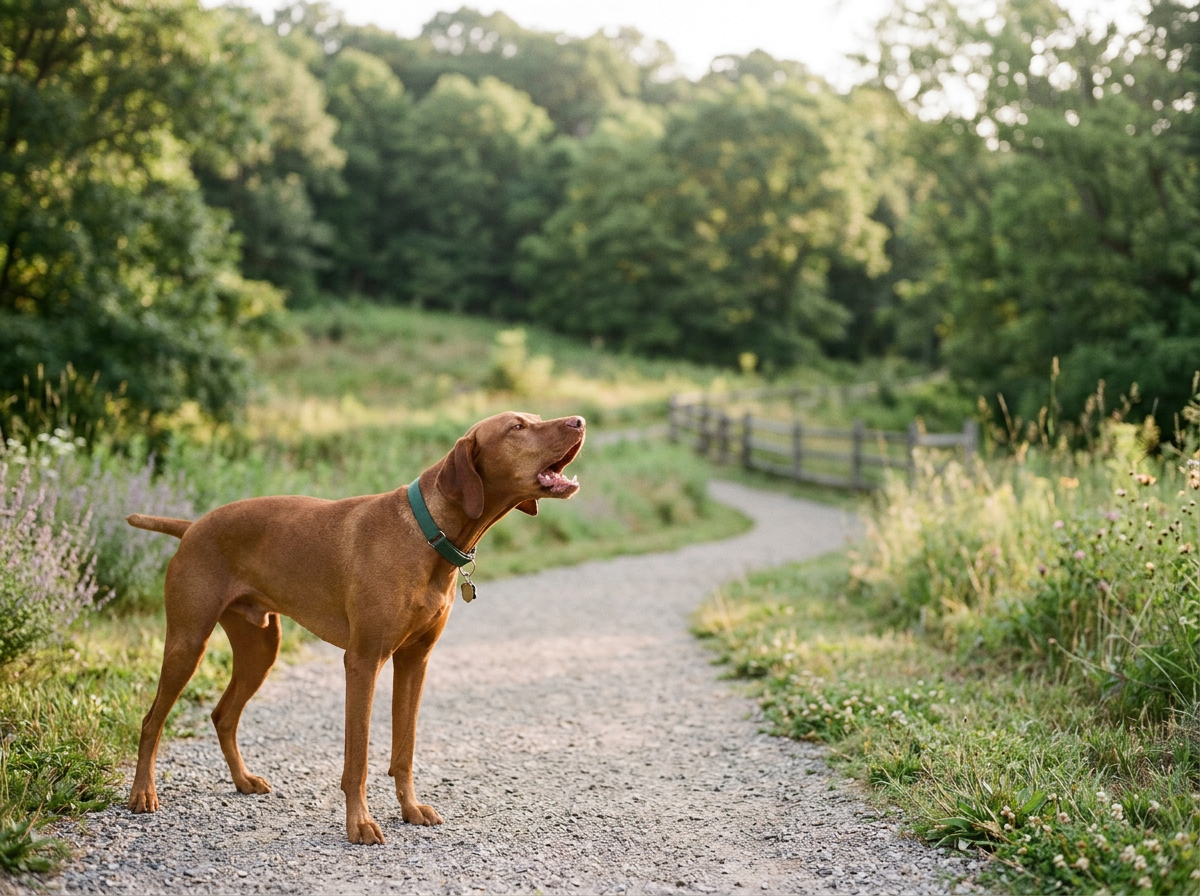
Learning how your dog talks to you is something most people look past. When you learn how you and your dog communicate to each other, training and day to day life can be easier and more peacful. There are so many ways we see on social media but its alot simpler than they show. You don’t need fancy buttons or bells. All you need to do is pay attention and communicate simply with your dog. However you chose to communicate with your dog, keep it consistent. You’ve got this!
Product includes detailed descriptions of dog’s behavior and how to put behaviors together, a chart that has behaviors with a quick meaning, and a fill in the blank for what your dog’s normals are. At the very end there’s a handler check in. Its always important to understand what your body language is telling your dog too.